Key Takeaways
- Most HOA special assessments come from hard assets that wore out faster than the reserve fund planned for: perimeter walls, sidewalks, paint, wrought iron, lighting, monuments and amenity structures.
- Arizona caps regular assessment increases at 20% over the prior year without majority member approval (A.R.S. § 33-1803), which is one reason underfunded boards end up reaching for a special assessment instead.
- A planned maintenance calendar built around Phoenix heat and the summer monsoon catches small failures before they become emergency capital projects.
- Written contractor scopes with quantities, condition photos and phasing options give the reserve study real numbers to work from.
- Large projects can usually be phased across budget years instead of funded in one lump sum.
Reserves & Capital Planning · HOA Board & Community Manager Guide · Phoenix Metro
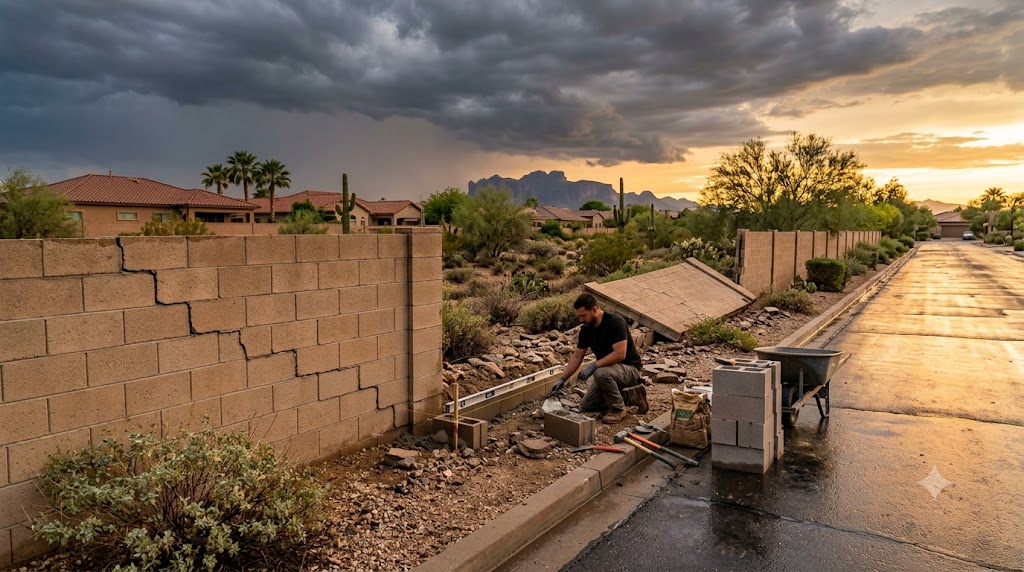
The most reliable way to avoid an HOA special assessment is to maintain common-area hard assets on a schedule, so they never fail all at once. In the 1990s and 2000s master-planned communities that fill Gilbert, Mesa, Chandler, Queen Creek and the West Valley, the surprises that trigger special assessments are rarely exotic. They are CMU perimeter walls pushed over by monsoon winds, sidewalk panels lifted into trip hazards, a repaint cycle skipped twice, rusted view fence, dead light poles and sun-faded entry monuments. This guide is written for HOA boards and community managers. It covers what a special assessment is, why they happen, a maintenance calendar timed for the Valley, and how to get contractor scopes that make your reserve study accurate.
What Is an HOA Special Assessment?
An HOA special assessment is a one-time charge billed to every owner, on top of regular dues, to pay for a cost the budget and reserve fund cannot cover. Boards typically levy one when a major component fails early, when the reserve fund is short of what a planned replacement costs, or when an emergency repair cannot wait for the next budget cycle. Whether the board can levy it on its own, and how much, comes from the community’s declaration and bylaws.
Arizona law adds context boards should know. Under A.R.S. § 33-1803, unless the community documents set a lower limit, a planned community association “shall not impose a regular assessment that is more than twenty percent greater than the immediately preceding fiscal year’s assessment without the approval of the majority of the members.” That section governs regular assessments. It does not address special assessments, so the authority and approval rules for those come from your governing documents. The practical lesson: an association that holds dues flat for years cannot always catch up in one budget, and a large shortfall tends to surface as a special assessment.
Why Arizona HOAs End Up With Special Assessments
Special assessments usually trace back to three causes: deferred maintenance, an underfunded reserve, or an emergency failure nobody budgeted for. Each one is common on hard assets in the Phoenix metro because heat, sun and summer storms shorten the life of exposed materials.
- Deferred maintenance: a small mortar repair left alone becomes a leaning wall panel; a skipped repaint lets stucco and wrought iron deteriorate until the job is rebuild, not refresh.
- Underfunded reserves: the reserve study assumed a useful life or a unit cost that no longer matches field conditions or current pricing.
- Emergency failures: a vehicle drives through a perimeter wall on an arterial street, a monsoon microburst drops several panels of block wall, or a haboob knocks out light poles along a common-area walkway.
Emergency failures are the hardest to plan for, but they are also where documentation pays off. A vehicle-damage wall can often be recovered from the driver’s insurer, and wind damage may be a claim on the association’s master policy. Both go faster when the board already has photos of the wall’s prior condition and a contractor who can produce a written scope the adjuster can review. Our guide to block wall repair in Arizona covers the repair-or-rebuild decision on walls specifically.
A Phoenix-Area Maintenance Calendar for Common-Area Hard Assets
A planned maintenance calendar for an Arizona HOA should be built around two facts: summer heat limits when paint and concrete can be applied, and the monsoon (roughly mid-June through September) is when walls, fences, poles and trees take the most damage. Scheduling inspections before and after storm season, and pushing coatings and pours into the cooler months, prevents most of the failures that turn into capital surprises. Use this as a starting framework and adjust it to your community’s components.
| When | Assets | What to Do | Why It Matters in the Valley |
|---|---|---|---|
| January to March | Paint, wrought iron, monuments, ramadas | Bid and complete repaint and coating projects; spot-treat rust on view fence and culvert railings | Moderate temperatures give coatings the cure windows they need before summer |
| March to May | Perimeter and theme walls, view fence, gates | Pre-monsoon wall walk; repair mortar joints, cracks and loose caps; check gate hinges and latches | Weak panels and loose caps are what monsoon outflow winds knock over first |
| April to May | Sidewalks, curbs, concrete | Survey trip hazards; grind or replace panels; schedule pours before peak heat | Concrete placed in 110°F afternoons cures too fast; summer pours move to early morning |
| May to June | Light poles, fixtures, electrical to irrigation timers | Light inspection; repair or replace damaged poles; plan LED conversions | Dark walkways are a liability, and storm season adds outages |
| June to September | All exposed assets | Storm response; document and secure damage; early-morning work only for coatings and pours | Monsoon wind, dust and debris do the most damage of the year |
| October | Walls, fence, poles, amenity structures | Post-monsoon inspection; scope repairs for the coming budget; photograph conditions | Findings feed the next budget and reserve study update |
| November to December | Lighting, monuments, amenity structures | Holiday lighting install and removal; carpentry and pergola repairs; finalize next year’s phased projects | Board budget approvals often land late in the year |
The calendar works best when each line has an owner and a vendor. Boards that assign the wall walk, the trip-hazard survey and the light inspection to a named contractor tend to get findings on time. Our HOA monsoon maintenance checklist goes deeper on the pre-storm items, and our page on sidewalk trip hazard repair for HOAs covers grinding versus panel replacement. For repaint planning and color-palette approvals, see HOA painting.
How Contractor Scopes Make Your Reserve Study Accurate
A reserve study is only as accurate as the quantities, conditions and costs that go into it, and field-verified contractor scopes are the best source for all three. Reserve specialists estimate remaining useful life and replacement cost; a trade contractor who walks the property can tell the board how many linear feet of wall are actually leaning, how many sidewalk panels exceed a trip-hazard threshold, and what the repaint really involves. Ask every contractor bidding common-area work to provide:
- Measured quantities: linear feet of wall, square feet of paint, number of sidewalk panels, number of poles and fixtures.
- Condition ratings with photos: each item tagged as sound, repair now, or plan replacement, with a dated photo.
- Repair versus replace options: what it costs to extend the asset’s life now compared with replacing it later.
- Phasing options: the same scope broken into logical sections the board can fund over more than one year.
Hand those scopes to your reserve study provider at the next update. Arizona’s resale disclosure statute, A.R.S. § 33-1806, lists the association’s “most recent reserve study, if any” among the documents provided to buyers, along with any special assessment the board has approved but not yet assessed. The words “if any” mean the statute anticipates communities without a study, so check your declaration for a reserve study requirement and ask your attorney or management company whether one applies. Either way, a current study backed by real field numbers is what keeps a board from being surprised. Our guide to what repairs HOAs are responsible for in Arizona helps sort which components belong on the association’s list in the first place.
Phasing Large Projects Across Budget Years
Phasing a large capital project across two or three budget years is often the difference between a planned reserve draw and a special assessment. A perimeter wall rebuild, a community-wide repaint or a sidewalk replacement program can usually be split by street, by section of wall or by building, with the worst-condition sections first. Phasing works when three conditions are met:
- Safety items go first: leaning wall panels, trip hazards and dark walkways are liability exposure and should not wait for a later phase.
- Each phase is self-contained: a finished section should match the community’s approved color palette and materials, so the property never looks half-done.
- The scope is fixed up front: the board approves the full scope once, then funds it phase by phase, so pricing and specifications stay consistent.
Phasing also smooths the regular assessment. Because A.R.S. § 33-1803 limits regular assessment increases to 20% per year without majority member approval, spreading capital work over several years lets a board fund it through gradual, budgeted increases and reserve contributions.
Document Conditions With Photos Every Year
An annual photo record of every major common-area asset is one of the cheapest protections a board has against special assessments. Dated photos show the reserve study provider how fast components are actually deteriorating, support insurance claims after monsoon or vehicle damage, and give new board members the history they would otherwise have to reconstruct. A simple standard works:
- Photograph each wall section, monument, ramada, gate and light pole from the same position each year, ideally in October after the monsoon.
- Name files by location and date, and store them where the management company and the board can both reach them.
- Attach photos to every repair scope and every completed work order, so the record shows before and after.
Financial records matter as much as condition records. Under A.R.S. § 33-1810, unless the community documents require a CPA audit, the board “shall provide for an annual financial audit, review or compilation of the association,” completed within 180 days after fiscal year end and available to members on request. Pairing that annual financial review with an annual condition record gives the board a clear picture of whether reserves are keeping pace with the assets.
How Arizona Experts Supports Capital Planning for HOAs
Arizona Experts is an HOA-focused general contractor with eight dedicated trade divisions, so one vendor can walk the property and scope walls, concrete, paint, iron, lighting and amenity structures together. Trade Experts. Not Handymen. Our masonry division handles perimeter wall rebuilds, accident-damage wall repairs and monument rebuilds; concrete handles sidewalk panels, trip-hazard grinding and curbs; painting handles ramadas, monuments, wrought iron and culvert railings; welding handles view fence, gates and railings; carpentry handles pergolas, fascia and balconies; and lighting handles light inspections, pole repair and LED conversions. See the full list on our HOA contractor page. Before hiring any contractor for common-area work, confirm the license class and status on the Arizona Registrar of Contractors site. Arizona Experts LLC holds AZ ROC License #301163, class KB-2 Dual Residential and Small Commercial.
Frequently Asked Questions
How can an HOA avoid special assessments?
Keep the reserve study current with field-verified quantities and costs, fund reserves at the level it recommends, and maintain hard assets on a calendar so small repairs never become emergency rebuilds. Phasing large projects across budget years and documenting conditions with annual photos close most of the remaining gaps.
Who pays for special assessments?
Every owner in the association pays a share, usually allocated the same way regular assessments are allocated under the declaration. When a special assessment is approved but not yet billed and a home sells, Arizona’s resale disclosure statute (A.R.S. § 33-1806) requires the association to disclose it to the buyer.
How does an HOA assessment work?
Regular assessments are the recurring dues that fund the operating budget and reserve contributions. A special assessment is a separate, one-time charge for a specific cost. In Arizona planned communities, regular assessments cannot rise more than 20% over the prior year without majority member approval unless the community documents set a lower limit (A.R.S. § 33-1803).
Does Arizona require HOAs to have a reserve study?
The Planned Communities Act refers to the association’s most recent reserve study “if any” in its resale disclosure list (A.R.S. § 33-1806), which suggests a study is not universal. Your declaration may still require one. Check your CC&Rs and ask your association’s attorney.
What common-area assets cause the most special assessments in the Phoenix area?
In Valley master-planned communities, the usual causes are CMU perimeter walls damaged by monsoon wind or vehicles, sidewalks lifted by roots and soil movement, deferred repaints of stucco, monuments and wrought iron, failing light poles, and amenity structures like ramadas and pergolas exposed to years of sun.
Get Field Numbers for Your Next Reserve Update
Get a written quote for your community’s next project: a scoped, phased bid with quantities and condition photos your board can approve at its next meeting.
Or call our Gilbert office: (623) 205-7040
(623) 205-7040
219 S. William Dillard Dr, Suite 123, Gilbert, AZ 85233
Mon–Fri 7am–4pm
AZ ROC License #301163 (KB-2 Dual)