Key Takeaways
- Responsibility for block wall repair in Arizona depends on where the wall sits: your lot, a shared lot line, or HOA common area.
- Arizona has no statute forcing neighbors to split wall costs — your recorded plat, CC&Rs, or a party-wall agreement controls.
- Monsoon wind, expansive soil, and tree roots cause most Valley block wall failures; monsoon season runs June 15–September 30.
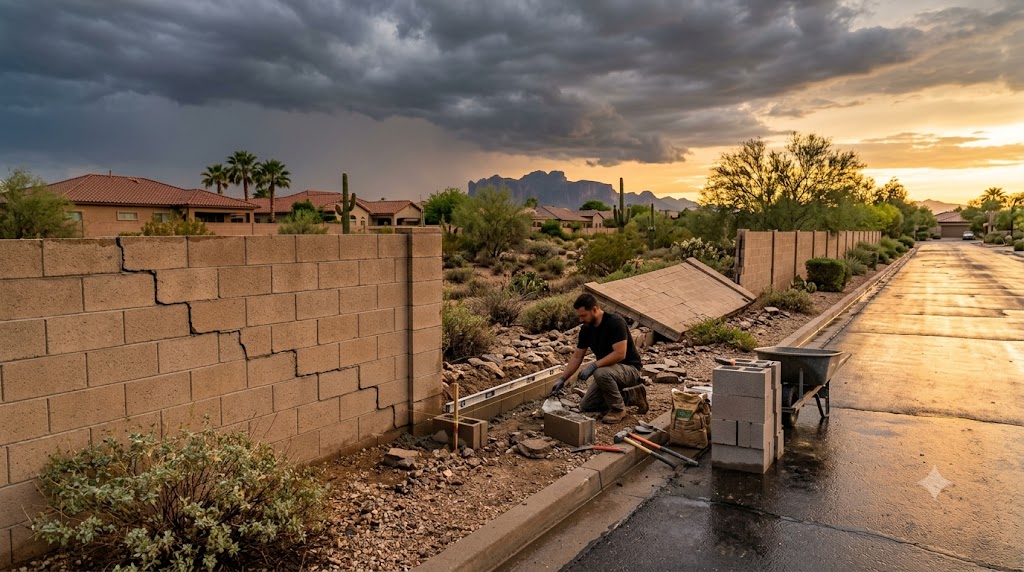
- Stair-step cracks in mortar joints can usually be repaired; a wall leaning more than about an inch typically needs panel rebuilds.
- In Phoenix, walls and fences over 3 feet tall need a building permit; other Valley cities set their own rules.
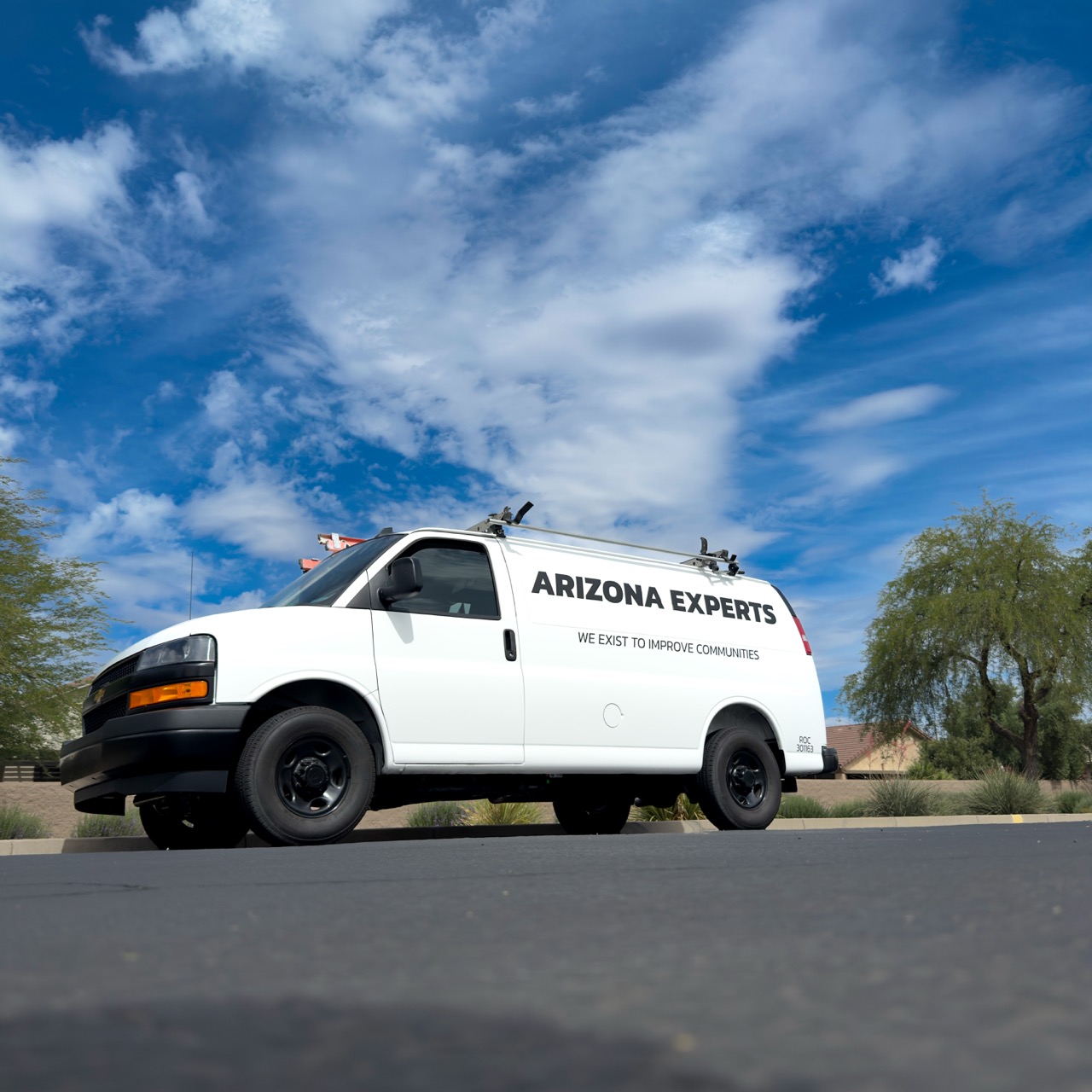
- Verify any masonry contractor’s license class at roc.az.gov before signing — Arizona Experts holds ROC #301163.
Masonry · HOA Board & Community Manager Guide · Phoenix Metro
Block wall repair responsibility in Arizona depends on where the wall sits: your lot, a shared lot line, or HOA common area. Nearly every 1990s–2000s master-planned community in the Phoenix metro — from Val Vista Lakes and Power Ranch in Gilbert to communities across Mesa, Chandler, and Queen Creek — is ringed by CMU (concrete masonry unit) block walls, and after every monsoon our masonry division fields the same two calls from community managers and boards: which walls is the association actually responsible for, and can they be repaired or do they need a rebuild? This guide answers both for HOA managers, board members, and commercial property managers, using the same criteria our crews apply on Valley wall projects. For everything else we do for associations, see our HOA contractor page.
Who Is Responsible for Block Wall Repair in Arizona?
The owner of the land the wall sits on is responsible for repairing it — and for walls on a shared lot line, responsibility is normally set by your community’s recorded documents, not by state law. Arizona has no statewide statute that forces neighbors to split fence or wall costs, so the controlling documents are your recorded plat, your CC&Rs, or a party-wall agreement. In HOA communities, the Arizona Planned Communities Act (A.R.S. Title 33, Chapter 16) requires the association to maintain what its CC&Rs designate as common area. In practice, block walls fall into three buckets:
- Walls entirely on your lot: the homeowner repairs them, subject to HOA architectural (ACC) approval on visible changes like paint color or block style.
- Shared “party” walls on the lot line: both neighbors typically share the wall, and most Valley CC&Rs make adjoining owners split repair costs unless one party caused the damage.
- Perimeter, view-fence, and common-area walls: the HOA maintains these — which is why community managers, not homeowners, hire us for most large wall rebuilds.
For managers, this three-bucket framework is the fastest way to triage wall complaints: when a homeowner demands the association fix an interior lot-line wall, the plat and CC&Rs usually put that cost back on the adjoining owners — but when a wall bordering a wash, arterial street, or greenbelt fails, it’s almost always an association asset even where it touches private lots, and it belongs in the maintenance budget. Homeowners modifying walls without approval create their own liability for the association; we covered that enforcement side in what happens if someone builds without HOA approval.
What Makes Block Walls Fail in the Phoenix Metro?
Most Valley block wall failures come from monsoon wind loading, expansive clay soil movement, and tree root pressure — not from the block itself wearing out. The National Weather Service defines Arizona’s monsoon season as June 15 through September 30, and outflow winds ahead of Valley storms routinely topple full panels of unreinforced or poorly grouted walls, especially older walls where rebar was spaced too widely. The other common culprits we see on repair calls across Gilbert, Mesa, Chandler, and Phoenix:
- Soil movement: expansive clays and irrigation water under footings cause stair-step cracking along mortar joints.
- Tree and shrub roots: sissoo trees and ficus planted near walls lift footings and push panels out of plumb.
- Vehicle impacts: corner-lot walls along arterials take accident damage that requires partial panel rebuilds.
- Sun and moisture cycling: decades of 110°F summers deteriorate mortar joints and any stucco finish over the block.
For a deeper breakdown of crack patterns and what each one signals structurally, see our guide to the most common types of masonry wall failure in Phoenix. The same soil and root movement lifts the sidewalk panels that run along community walls; our page on sidewalk trip hazard repair for HOAs covers that side.
Repair or Rebuild? How Our Masonry Crews Decide
A block wall can usually be repaired if the damage is limited to mortar joints or a few blocks and the wall still stands plumb; it needs panel rebuilds once it leans, bows, or shows displaced footings. Repointing mortar, epoxy crack injection, and replacing individual damaged blocks preserve the existing wall. A leaning wall can’t be pushed back — the affected panels are demolished to the footing and re-laid with new block, rebar, and grout, then color-matched to the community’s approved palette. Here’s the field test we use:
| Symptom | Typical Fix | Repair or Rebuild? |
|---|---|---|
| Hairline or stair-step cracks in mortar joints, wall plumb | Repointing / crack repair | Repair |
| A few cracked or spalled blocks, sound footing | Individual block replacement | Repair |
| Failing stucco finish over sound block | Stucco repair and recoat | Repair |
| Wall leaning or bowing more than about an inch | Demolish and re-lay affected panels | Rebuild panels |
| Panels blown over by monsoon winds | New block, rebar, and grout on existing or new footing | Rebuild panels |
| Footing heaved by roots or soil movement | Root remediation plus new footing and panels | Rebuild panels |
Cost follows that same line: joint and crack repairs sit at the low end, while panel rebuilds are priced by the linear foot and rise with wall height, footing condition, and access. We published Gilbert-specific numbers in how much walls cost to repair in Gilbert, AZ. One scheduling note unique to the desert: in summer we pour footings and grout early in the morning, because mortar and grout that cure too fast in 110°F afternoons lose strength.
Hiring a Block Wall Contractor: Verify the License First
Before hiring anyone for structural block wall work in Arizona, verify their license on the Arizona Registrar of Contractors contractor search — an unlicensed crew leaves you with no recovery-fund protection and possible permit problems. Check that the license is active, bonded, and in a class that covers the work. Arizona Experts LLC holds AZ ROC License #301163 (KB-2, Dual Residential and Small Commercial), with a dedicated masonry division that handles perimeter wall rebuilds, accident-damage repairs, monument rebuilds, and stucco over block for HOAs and commercial properties across the Valley. License class matters for boards specifically: an improperly licensed vendor can void warranty positions and expose the association — one of several vendor traps we detailed in how HOA managers can avoid costly contractor mistakes. Permits matter too: Phoenix’s fence permit guidance exempts fences no more than 3 feet high at one- and two-family homes and townhouses, requires a building permit for zoning and site drainage up to 6 feet, and requires a permit showing building-code compliance above 6 feet. Every Valley city sets its own thresholds, so confirm with the city’s permit office (for example, Phoenix Planning & Development) before a rebuild.
Real feedback from a Google review of our block wall work:
Block wall repairs done right, with clear communication from estimate to completion. — Jeff Cohen
Frequently Asked Questions
Who pays for a shared block wall between neighbors in Arizona?
Usually both adjoining owners split the cost — not the HOA. Arizona has no statute assigning shared-wall costs, so the recorded plat, CC&Rs, or a party-wall agreement controls, and most Valley CC&Rs make adjoining owners share interior lot-line wall repairs equally unless one owner caused the damage. For managers, this is the answer to send when a homeowner asks the association to pay for a lot-line wall.
Is the HOA responsible for the perimeter wall around my community?
In most Phoenix-metro master-planned communities, yes. Perimeter and theme walls are typically designated common area in the CC&Rs, and the Arizona Planned Communities Act requires the association to maintain its common areas. Interior lot-line walls, by contrast, usually belong to the homeowners on either side.
Do I need a permit to rebuild a block wall in Phoenix?
Usually, yes. Phoenix exempts only fences and walls no more than 3 feet high at one- and two-family homes and townhouses; up to 6 feet, a building permit covers zoning and site drainage, and above 6 feet the permit must also show building-code compliance. Gilbert, Mesa, Chandler, and other Valley cities set their own thresholds, so confirm with your city’s permit office before demolition starts.
Can monsoon damage to community walls be claimed on the HOA master policy?
Often, yes — wind is a covered peril on many association master policies, though walls and fences may carry sub-limits or separate wind deductibles that make small single-panel claims not worth filing. Photograph the damage immediately, get a written repair scope from a licensed contractor, and let the adjuster review it before rebuilding.
How should an HOA budget for block wall repairs?
Treat perimeter walls as a reserve-study line item, not a surprise operating expense. Walk the walls annually before monsoon season, repair mortar joints and cracks as operating maintenance, and phase larger panel rebuilds across budget years with a scoped, per-linear-foot bid the board can approve at a regular meeting.
How long does block wall repair take in the East Valley?
Mortar and crack repairs are usually finished in a day. Panel rebuilds run two to five working days depending on length, footing condition, and grout cure time — longer in summer, when we schedule pours for early morning to protect cure strength.
Get Your Block Wall Assessed Before the Next Storm
Get a written quote for your community’s next wall project — a scoped bid your board can approve at its next meeting.
Or call our Gilbert office: (623) 205-7040
(623) 205-7040
219 S. William Dillard Dr, Suite 123, Gilbert, AZ 85233
Mon–Fri 7am–4pm
AZ ROC License #301163 (KB-2 Dual)