Key Takeaways
- Arizona’s 2026 monsoon season runs June 15 through September 30 — the season is active right now, and storms keep coming through late September.
- A documented walkthrough of walls, fences, lighting, drainage, and shade structures cuts emergency repair spending and protects the association from liability claims.
- The highest-risk assets in a monsoon are unreinforced block wall panels, loose view-fence sections, aging light poles, and clogged culverts.
- Photograph everything and convert findings into scoped work orders — insurance adjusters and boards both act faster on documentation.
- After a storm, triage in this order: exposed electrical, leaning or downed walls, blocked drainage, then cosmetic damage.
Community Management · Seasonal Operations · Phoenix Metro
A pre-monsoon walkthrough is a documented, asset-by-asset inspection of a community’s walls, fences, lighting, drainage, and structures before Arizona’s storm season peaks. The National Weather Service sets the 2026 monsoon season at June 15 through September 30, and every year our crews rebuild the same failures across Gilbert, Mesa, Chandler, and Queen Creek communities — most of which showed warning signs a manager could have caught in a one-hour walk. This checklist is the one we use, organized by the eight trades we run, so a community manager or board member can walk any property in the Valley and leave with a work-order list instead of a vague concern. And if your communities haven’t been walked yet this season: mid-July is the second-best time. The strongest storm weeks are usually still ahead.
Why Walk the Property Before the Storms Peak?
Because monsoon damage is rarely random — storms finish what deferred maintenance started. An outflow wind doesn’t knock down a healthy, grouted block wall; it knocks down the panel that already had stair-step cracks. A microburst doesn’t snap a sound light pole; it snaps the one with a corroded base plate. Boards see this in the budget: communities that walk their assets each spring convert most monsoon work into planned, bid, board-approved repairs, while communities that don’t pay emergency rates in August. There’s also a liability layer — under the Arizona Planned Communities Act (A.R.S. Title 33, Chapter 16), the association maintains its common areas, and a documented inspection record is the board’s best evidence of reasonable care if a wall, tree limb, or fixture injures someone. It’s the “Plan to Win” principle we apply to our own maintenance contracts, and it pairs with the framework in our guide to the 3 Ps of maintenance.
The Asset-by-Asset Monsoon Checklist
Walk the perimeter first, then interior common areas, and score every item as OK, monitor, or work order. These are the failure points our eight trade divisions get called on most after Valley storms:
| Asset | What to Look For | Monsoon Risk if Ignored |
|---|---|---|
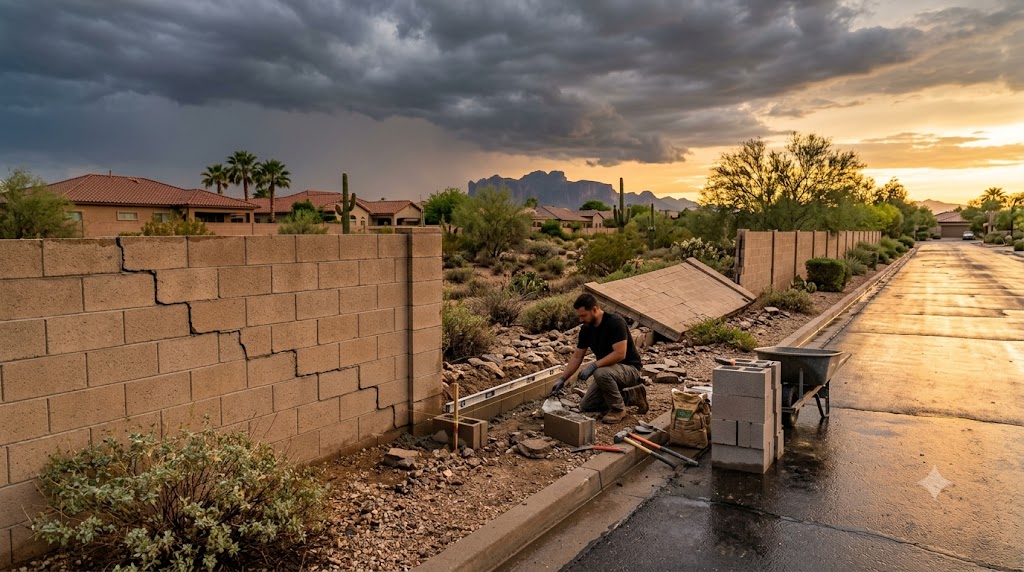
| Block walls & monuments | Stair-step cracks in mortar joints, leaning or bowing panels, spalled block, cracked monument caps | Outflow winds topple compromised panels; falling walls are the top injury and claim risk |
| View fence & gates | Rusted-through pickets and posts, loose panel connections, pool and pedestrian gates that don’t self-close and latch | Wind-loosened sections fail; a non-latching pool gate is a code violation and drowning liability |
| Sidewalks & drainage | Trip hazards over 1/4 inch of vertical displacement, silted culverts, blocked scuppers and drainage channels | Storm runoff undermines panels and floods turf; standing water accelerates wall footing damage |
| Light poles & fixtures | Corrosion at base plates, loose anchor bolts, exposed conductors, dark fixtures along walking paths | Microbursts snap corroded poles; dark paths during storm outages compound liability |
| Ramadas, pergolas & fascia | Dry-rotted posts and beams, lifted roofing panels, peeling fascia, loose lattice | Wind converts loose lumber and panels into projectiles across common areas |
| Paint & stucco | Cracked or delaminating stucco, chalking paint on sun-facing elevations, failed sealant at penetrations | Monsoon moisture enters open stucco cracks and expands damage through the block beneath |
| Signage, flagpoles & site furniture | Leaning sign posts, loose dog stations and bulletin boards, unanchored benches and parking stops | Unanchored fixtures become wind hazards; downed entry signage goes unrepaired for months |
| Electrical & irrigation | Damaged conduit, exposed splices, waterlogged valve boxes, irrigation timers without surge protection | Lightning and water intrusion take out controllers and create shock hazards |
Two Valley-specific notes. First, check SRP and APS equipment boxes in your common areas for peeling paint and graffiti now — utility box painting is a quick pre-storm win that avoids repainting fresh work after dust storms. Second, on walls specifically, the difference between a repairable crack and a rebuild is covered in our breakdown of the most common masonry wall failures in Phoenix — bring that with you on the walk.
Document Everything Like an Adjuster Will Read It
The walkthrough only pays off if it produces records: date-stamped photos of every flagged item, a location note tied to a street or lot number, and a severity score. That file does three jobs at once. It becomes the scope for contractor bids, so the board approves a defined project instead of an open-ended estimate. It becomes the “before” evidence when a storm damages an asset and the association files on its master policy — adjusters move faster when pre-loss condition is documented. And it becomes the board’s due-diligence record. When findings turn into vendor selection, license verification at the Arizona Registrar of Contractors comes first — the vetting traps to avoid are in our guide on how HOA managers avoid costly contractor mistakes.
After the Storm: Triage in This Order
When a storm does hit, sequence the response by hazard, not by resident complaint volume:
- Exposed electrical: downed fixtures, snapped light poles, and damaged conduit get barricaded and made safe first.
- Leaning or downed walls: cordon off compromised panels immediately — a leaning wall can fail hours after the wind stops.
- Blocked drainage: clear culverts and scuppers before the next cell arrives; back-to-back storms cause most flood damage.
- Structural damage to shade structures and gates: secure, then schedule.
- Cosmetic damage: paint, stucco patches, and signage go into the normal bid cycle.
Photograph storm damage the same day, get a written repair scope from a licensed contractor, and let the association’s adjuster review it before rebuilding anything beyond safety mitigation.
Frequently Asked Questions
When is monsoon season in Arizona in 2026?
Arizona’s 2026 monsoon season officially runs June 15 through September 30, as defined by the National Weather Service. Storm activity in the Phoenix metro typically peaks from mid-July through August, so mid-season inspections still have real preventive value.
How often should an HOA walk its common areas?
At minimum twice a year: a full asset walkthrough in April or May before monsoon season, and a follow-up in October to document storm damage and set the next budget cycle. Communities with aging walls, mature trees, or extensive lighting benefit from quarterly walks.
Is the HOA responsible for monsoon damage in common areas?
Generally yes — the Arizona Planned Communities Act requires associations to maintain what their CC&Rs designate as common area, which typically includes perimeter walls, monuments, common-area lighting, and shade structures. Damage on individual lots usually falls to homeowners, subject to the community’s governing documents.
What monsoon damage counts as an emergency repair?
Anything creating an immediate safety hazard: exposed electrical, leaning or collapsed block walls, non-latching pool gates, and blocked drainage ahead of another storm. Emergency work should be limited to making the hazard safe; full repairs should still go through a scoped, board-approved bid.
Can one contractor handle the whole checklist?
Only if they self-perform the trades involved. Arizona Experts runs dedicated masonry, welding, concrete, lighting, electrical, carpentry, painting, and handyman divisions under one AZ ROC license (#301163), which is why community managers use a single walkthrough report to generate one coordinated scope instead of chasing six vendors.
Turn Your Walkthrough Into One Scoped Bid
Send us your findings — or have our division leads walk the property with you — and get a written, per-item scope your board can approve at its next meeting.
Or call our Gilbert office: (623) 205-7040
(623) 205-7040
219 S. William Dillard Dr, Suite 123, Gilbert, AZ 85233
Mon–Fri 7am–4pm
AZ ROC License #301163 (KB-2 Dual)